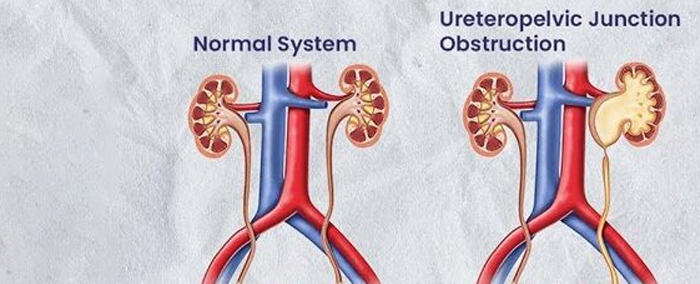
PUJ obstruction, also called ureteropelvic junction obstruction, is a condition where the connection between the renal pelvis (the area of the kidney that collects urine) and the ureter becomes narrowed or blocked. This obstruction prevents urine from flowing freely from the kidney into the ureter, causing urine to accumulate and the kidney to swell, a condition known as hydronephrosis. PUJ obstruction is one of the most common causes of urinary tract dilation in infants and children.
The condition may be present at birth (congenital) or acquired later. Congenital PUJ obstruction often results from abnormal development of the muscle at the junction, a narrow segment, or a blood vessel crossing the ureter and causing compression. Acquired cases may arise after trauma, infection, or previous surgery.
Many cases are detected prenatally through routine ultrasound, where the kidney appears swollen. After birth, symptoms may include abdominal mass, recurrent urinary tract infections, vomiting, poor feeding, flank pain, or crying during urination. Older children may complain of pain after fluid intake or during physical activity.
Diagnosis involves ultrasound, renal scan (such as a MAG-3 scan), and sometimes MRI or CT scan to assess kidney drainage and function. These tests help determine the severity and whether surgery is needed.
Treatment depends on the degree of obstruction and kidney function. Mild cases may be monitored with regular ultrasounds, as some improve on their own. However, significant obstruction requires surgical correction called pyeloplasty, where the narrowed segment is removed and the healthy ends are reconnected. Minimally invasive laparoscopic or robotic pyeloplasty techniques offer quicker recovery and excellent outcomes.
If left untreated, severe PUJ obstruction can cause repeated infections, kidney damage, stones, or loss of kidney function. Early diagnosis and prompt treatment help preserve kidney health and prevent long-term complications.
Most children recover fully after surgery, with normal kidney function and no long-term issues. Follow-up imaging ensures proper healing and continued kidney drainage.